Investment Grade Diamonds: What Makes a Diamond Worth Investing In?
Most diamonds sold anywhere in the world, however large, however expensive, were never built to hold or grow value. They were built to be worn. Somewhere within that much larger market sits a far smaller category, defined by specific and measurable qualities, that behaves nothing like the rest. Investment grade is not a phrase used to make a stone sound more impressive. It describes a narrow set of criteria that either apply to a diamond or do not. This article is about recognising that category, not about shopping for jewellery.
A diamond you wear and a diamond you hold are different assets
A retail diamond is priced on appearance, brand, and setting. Two stones can look nearly identical and carry very different prices depending on where they were bought and how they were marketed. An investment grade stone follows an entirely different logic. Its price is built on rarity that can be independently verified, not on how it photographs or which boutique sold it.
The two markets barely intersect. A beautiful engagement ring and a serious investment asset can sit side by side in a display case and belong to completely different economic categories. Understanding where that line falls is the difference between buying an asset and buying an experience, and both are perfectly valid, provided the buyer knows which one they are choosing.
What actually determines investment grade
Four factors decide which side of that line a diamond falls on. None of them are subjective, and none of them can be substituted with a good story from a seller.
Colour rarity above all else
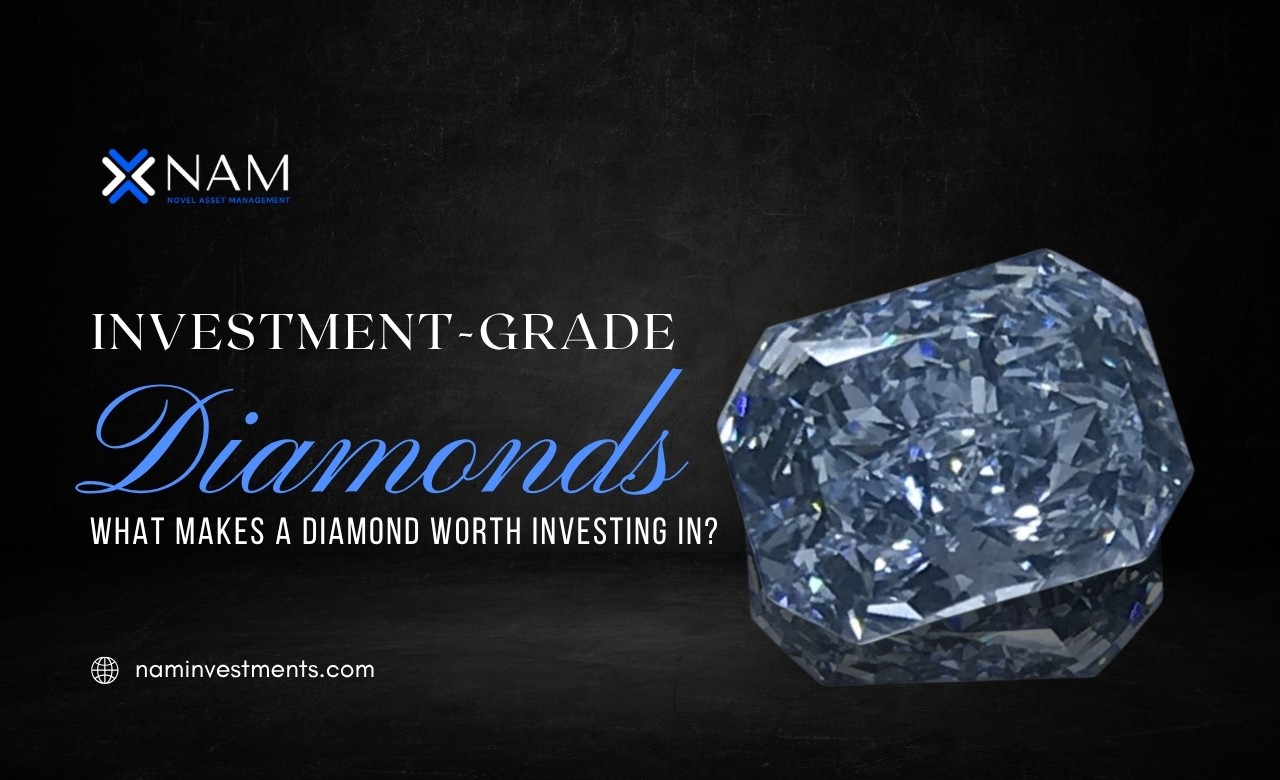
Fewer than one in ten thousand diamonds mined show natural fancy colour. Within that already narrow group, certain colours occur so rarely that only a handful of significant stones surface anywhere in the world in a given year. Blue and pink sit at the top of that hierarchy, followed by a smaller set of other natural colours that command similar attention among serious buyers. This single factor, more than carat weight or clarity, is what drives long term value in this category.
Intensity grading, not just hue
Colour rarity is only half the picture. Within any given colour, laboratories also grade intensity, on a scale that typically runs from faint through to vivid. A pale pink stone and a vivid pink stone can share the same hue and carry entirely different valuations, sometimes by a wide margin. This distinction is frequently lost on buyers outside the trade, who assume that naming the right colour is enough. Intensity is often what a grading report is really being consulted for, more than colour alone.
Independent certification, not a seller's word
A grading report from a recognised laboratory is what turns a claim into a fact. It confirms colour origin, treatment status, and clarity in a way no description from a seller can substitute for, however trustworthy that seller may seem. A stone offered as investment grade without this documentation is not investment grade, regardless of the price attached to it. This is one of the few places in the process where there is no room for a grey area.
Natural colour versus treated colour
This is the point where inexperienced buyers lose the most money, and it deserves direct language rather than a soft mention. Treated or laboratory enhanced colour can look identical to the eye, sit in a similar setting, and still be worth a fraction of a naturally coloured stone. It also carries none of the long term price history that makes natural colour diamonds worth holding in the first place. Confirming natural origin before any conversation about price is not optional.
Documented origin and chain of custody
Where a stone came from, how it moved from rough to polished, and who has held it along the way increasingly matter to serious buyers, and to whoever eventually buys it next. A well documented history adds confidence at the point of purchase and protects value at the point of resale, which is exactly when that confidence tends to matter most.
Why colour changes the entire value equation
Colourless diamonds, the kind most people picture when they hear the word, largely trade like a commodity. Grade, cut, and size move the price within a fairly predictable range, and supply is comparatively abundant. Fancy colour diamonds behave differently. They trade more like fine art with a verifiable rarity curve behind them, where each significant stone is genuinely singular rather than one of many similar options.
Pricing tracked over recent decades by the Fancy Color Research Foundation reflects that difference clearly, showing a pattern of steady long term appreciation across major colour categories. That pattern is worth studying on its own terms, as a reflection of historical behaviour rather than a promise of future returns, since no rarity based asset moves in a straight line forever.
Where investors lose money
This is worth stating plainly, because it is one of the most common ways serious money ends up in the wrong stone.
The first mistake is buying on visual appeal alone, without insisting on certification from a recognised laboratory first. A stone can be genuinely stunning and still hold no long term investment value if that documentation does not exist.
The second is paying full retail margin rather than seeking trade level access. That margin is rarely recovered on resale, no matter how strong the stone's underlying rarity is.
The third is failing to confirm treatment status before agreeing to a price, which as covered above can be the difference between a real asset and a convincing imitation.
The fourth is buying without any realistic sense of how or where the stone would eventually be sold. An asset without a credible exit path is not fully an asset yet, it is a purchase with unresolved questions attached to it.
The fifth, and one of the quieter mistakes, is entering with the wrong time horizon in mind. Significant stones typically move through global auction cycles over a period of years rather than months. An investor expecting a quick turn is measuring the wrong asset against the wrong clock, and disappointment in this category is usually a timing mismatch rather than a flaw in the stone itself.
What a credible seller should offer
A seller operating at the investment grade level, rather than the retail level, should make a handful of things available without needing to be asked twice.
Full certification should be offered upfront as a matter of course, not produced reluctantly after a buyer requests it. A buy back structure matters as well, since a seller genuinely willing to repurchase a stone is a seller with a real, tested view on its value rather than an interest that ends the moment payment clears. Secure, insured global storage and transport should also be part of the offering as standard, not an optional extra bolted on later. NAM's ecosystem around secure storage and fully insured logistics is a useful reference point for what this should look like in practice. Finally, real access to global auction liquidity, rather than a vague assurance that a buyer will eventually appear, is what separates a considered investment from a hopeful one.
Where provenance fits into this
Certification confirms what a stone is. Provenance confirms how it was found in the first place, and access to stones like this rarely comes from a general market. It tends to come from relationships built over decades of sourcing and grading at scale. Novel Collection's history in diamond manufacturing and trading since 1927 reflects exactly that kind of depth, the sort of access that allows a buyer to see significant stones before they reach a wider market rather than after. For anyone exploring which specific stones are currently available for this purpose, NAM's own stone selection reflects the same standards outlined throughout this piece.
Discipline, not instinct
Investment grade diamond ownership rewards discipline and access far more than it rewards visual instinct or luck. The buyers who do well in this category are rarely the ones who fell in love with a stone first and asked questions later. They are the ones who understood the criteria before they ever looked at a single diamond.
For anyone weighing a first acquisition in this category, a private consultation before any purchase is worth more than any amount of research done alone.
Related Insights
Further perspectives on rare tangible assets, portfolio strategy and market developments.